1958 IBM 610 SMALL COMPUTER PROGRAMMING CONTROL OFFPRINT IBM JOURNAL ORIGINAL PC
ITEM DESCRIPTION
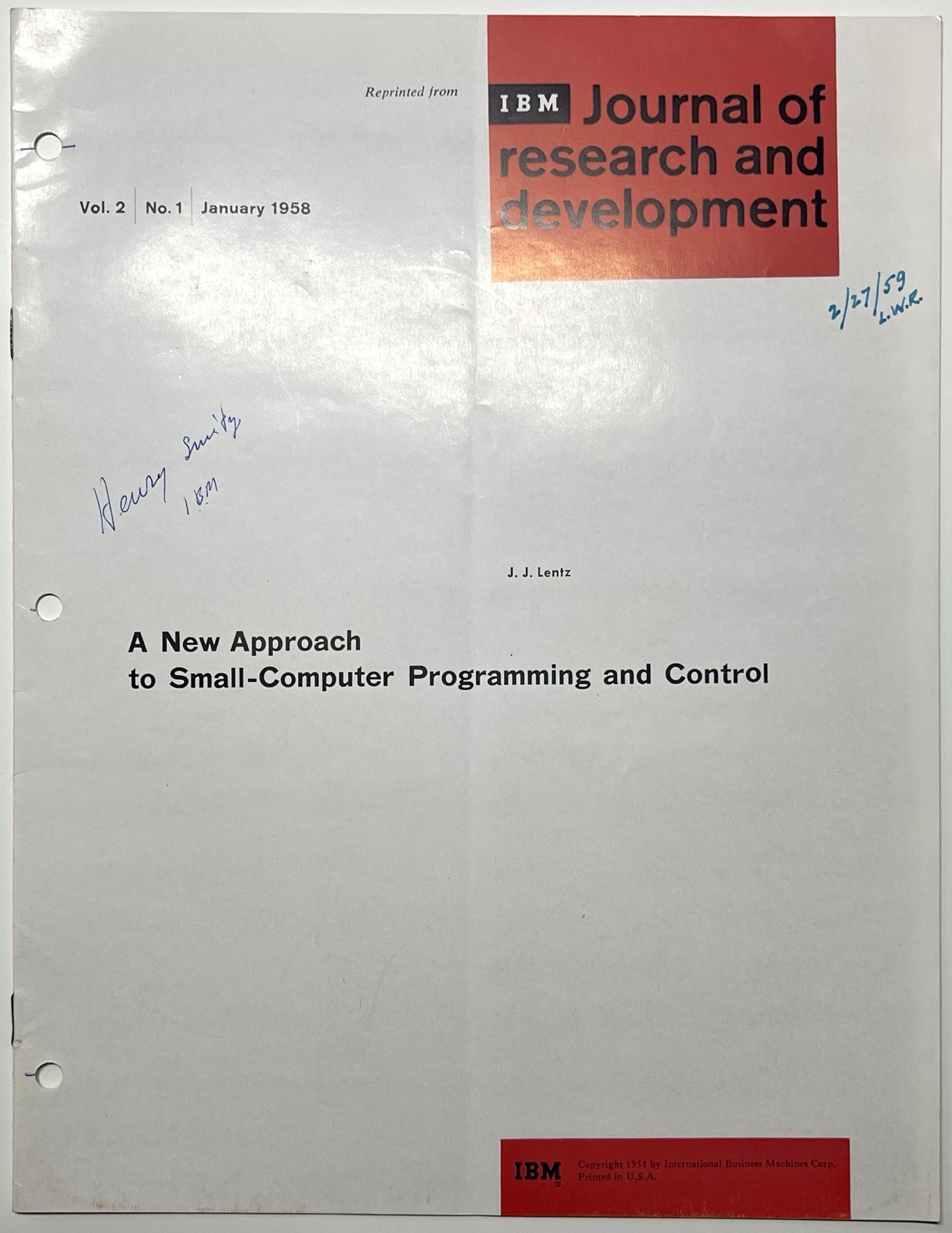
IBM Journal of Research and Development, Vol. 2, No. 1 (January 1958) offprint: “A New Approach to Small-Computer Programming and Control” by J. J. (John) Lentz, the principal designer of the IBM 610. This original IBM-printed reprint runs pp. 72–83 and documents the operating concepts of the IBM 610 Auto-Point Computer—one of the first single-operator, desk-side machines intended for office and engineering use. Lentz describes the machine’s auto-point floating-decimal arithmetic, keyboard-driven command structure, magnetic-drum storage, typed I/O through an IBM electric typewriter, program and data tape readers, and a pluggable control panel for higher-level routines. Figures show the 610 cabinet open to display construction (Fig. 1), a functional system diagram (Fig. 2), the keyboard console (Fig. 3), and the removable plugboard control panel (Fig. 4). Manuscript revision note dated November 5, 1957 appears at the end, reflecting the transition from laboratory model to production machine in this formative moment of interactive computing.
Clean, complete IBM house offprint, three factory staple holes at the fold and three round punch holes near the gutter for binder use. Light handling and surface rub consistent with storage; a soft vertical handling crease visible from prior folding/filing; small corner nudges. A couple of neat contemporary ink notes on the front wrapper (one dated 2/27/59; another brief name/initials in blue pen). Internally bright; paper retains good flexibility with no losses or tears noted—well-preserved for a 1958 technical offprint.
The IBM 610 is widely cited as an early “personal” or single-user computer: it allowed an engineer or accountant to solve problems interactively from the keyboard, observe typed output, and employ the auto-point mode for floating-decimal work without elaborate programming. Lentz’s article captures the user-level instruction set (SHIFT, COPY, ENTER, CLEAR, etc.), examples of solving simultaneous equations, program-tape and manual-keyboard control, response-class switches on the console, and the plugboard scheme enabling sophisticated subroutines.
For collectors of early computing, human-computer interaction, and IBM internal research, this is a primary, contemporary source direct from IBM R&D.
Make sure to see the photos above for complete details.
Measuresapproximately11 1/2 inches tall by 8 1/2 inches wide.
KEYWORDS
IBM 610, IBM 610 Auto-Point, auto-point, floating decimal, floating-point, small computer, early computer, single user computer, personal computing history, human computer interaction, HCI, interactive computing, magnetic drum, drum memory, IBM electric typewriter, keyboard console, response class switches, plugboard, pluggable control panel, control panel, program tape, data tape, tape reader, functional diagram, cathode ray tube indicator, typewriter output, simultaneous equations example, command structure, ENTER command, CLEAR command, SHIFT left, SHIFT right, COPY command, IBM Journal of Research and Development, IBM JRD, Vol 2 No 1, January 1958, offprint, reprint, technical paper, research report, J J Lentz, John Lentz, early programming, office computing, engineering computing, calculator replacement, mid century computing, 1950s computing, IBM history, computer history, vintage computing, retro computing, mainframe era, desk calculator successor, magnetic drum storage unit, arithmetic unit, access control unit, console keyboard, program control, iterative methods, automatic decimal positioning, auto point mode, typewriter I/O, figure 1 2 3 4, laboratory to production, primary source, collectible offprint, rare IBM publication
_gsrx_vers_1715 (GS 9.9.2 (1715))