1963 LIGHTNING EMPIRICIST PHILBRICK OP AMP JOURNAL P65A PDL6 PAYNTER DELAY ISSUE
ITEM DESCRIPTION
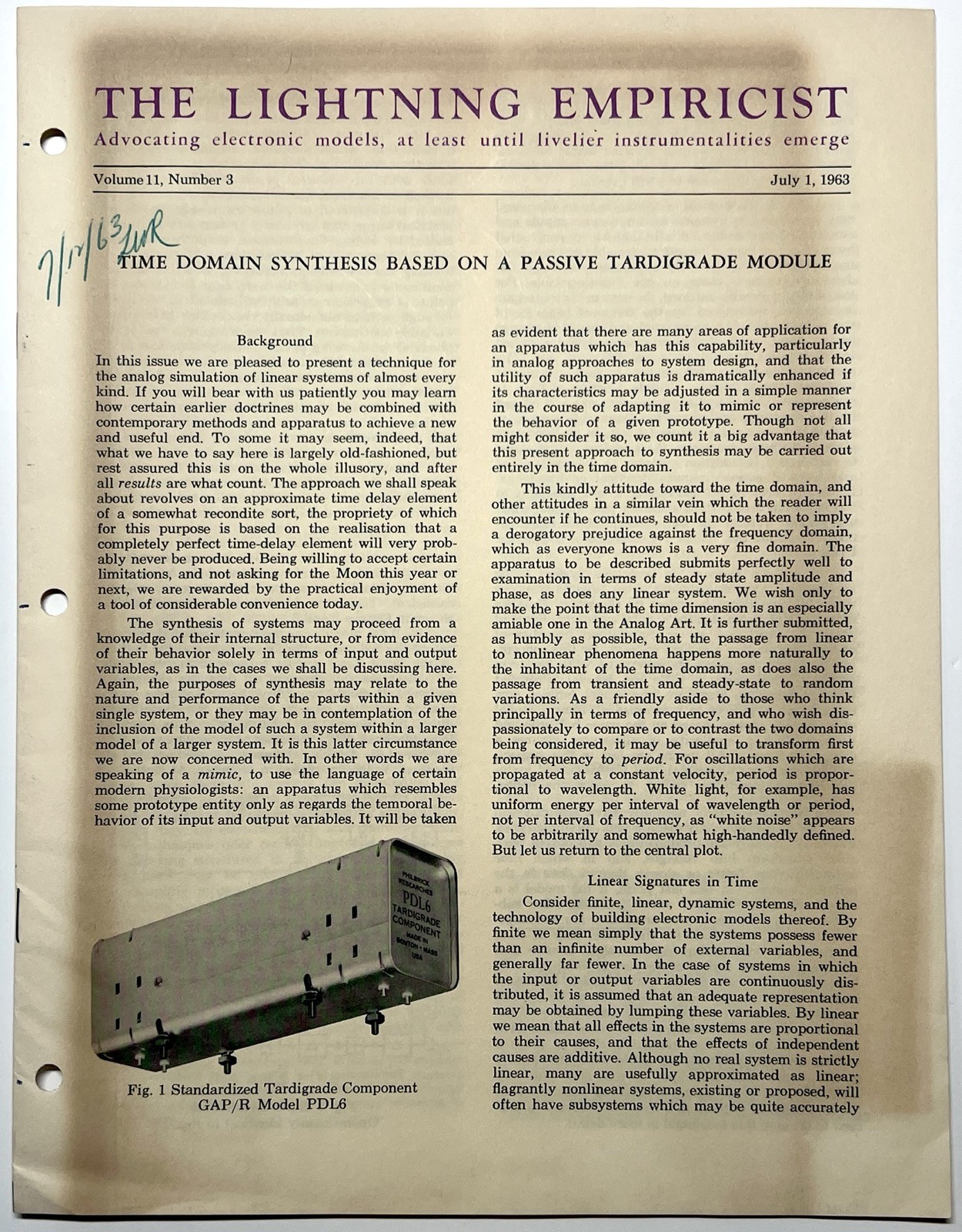
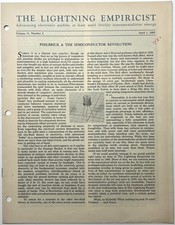
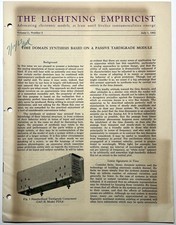
The Lightning Empiricist, Volume 11, Number 3 (July 1, 1963) — the influential house journal of George A. Philbrick Researches (GAP/R), the pioneering Boston firm that put practical operational amplifiers into laboratories, universities, and industry. This 12-page issue centers on a substantial technical article, “Time Domain Synthesis Based on a Passive Tardigrade Module.” It introduces GAP/R’s standardized “Tardigrade” delay element (GAP/R Model PDL6) and walks through time-domain synthesis using iterated delays, Paynter-type ladder networks, transient signatures, and control-systems responses, with numerous figures, equations, and graphed step-responses throughout.
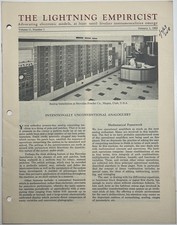
Historically important content includes a side discussion crediting R. A. Pease on a related filter approach and extended treatment of the MIT-affiliated Paynter delay-line method for synthesizing linear system behavior from measured transients. The back page carries Corporate News announcing GAP/R’s acquisition of Pastoriza Electronics, Inc. of Boston effective 1 July 1963—an event that shaped the firm’s capabilities in special-purpose instrumentation—and Product News detailing upgrades to the celebrated differential op-amp line: the P65 series “A” version (greater output, improved drift), notes on the P75, and new chopper and accessory developments. The imprint gives the classic Boston address (127 Clarendon Street) and identifies this as the third issue of the newly “revised & newly periodic” journal.
Condition. Clean, sound example showing the gentle, natural toning typical of early-1960s coated stock, a few soft handling waves, and light corner wear from normal use. Three binder holes run in the inner margins (consistent with lab filing practice for GAP/R literature). A small pencil date/initial at the upper front margin is present. Pages are supple, diagrams remain crisp, and there are no losses or intrusive stains observed—an honest, well-kept copy suitable for reference or display.
A scarce primary source for the history of analog computation, control theory, and the commercial evolution of the op-amp.
Make sure to see the photos above for complete details.
12 pages.
Measuresapproximately11 inches tall by 8 1/2 inches wide.
KEYWORDS
Lightning Empiricist, George A Philbrick Researches, GAP/R, Philbrick, Philbrick Researches, operational amplifier, op amp, analog computing, analog computer, analog simulation, control systems, time domain synthesis, transient response, step response, delay line, Paynter delay line, Paynter method, H P Paynter, MIT, R A Pease, Bob Pease, Pease filter, ladder network, impedance, system identification, signature method, transient signatures, PDL6, tardigrade module, standardized tardigrade component, P65, P65A, P75, differential amplifier, chopper amplifier, SP656, GAP/R Model K3 Little Black Box, GAP/R Model PDL6, corporate news, product news, Pastoriza Electronics, James J Pastoriza, acquisition, 127 Clarendon Street Boston, 1963 electronics, engineering ephemera, computing history, instrumentation history, servo, response, filters, approximation theory, electronic design, rare journal, vintage documentation, house organ, technical bulletin, graphs, equations, figures, Boston Massachusetts, early op amp history, laboratory instrumentation
_gsrx_vers_1723 (GS 9.9.3 (1723))