1963 LIGHTNING EMPIRICIST PHILBRICK RESEARCHES OP AMP P65 P66 P2 BOB PEASE ISSUE
ITEM DESCRIPTION
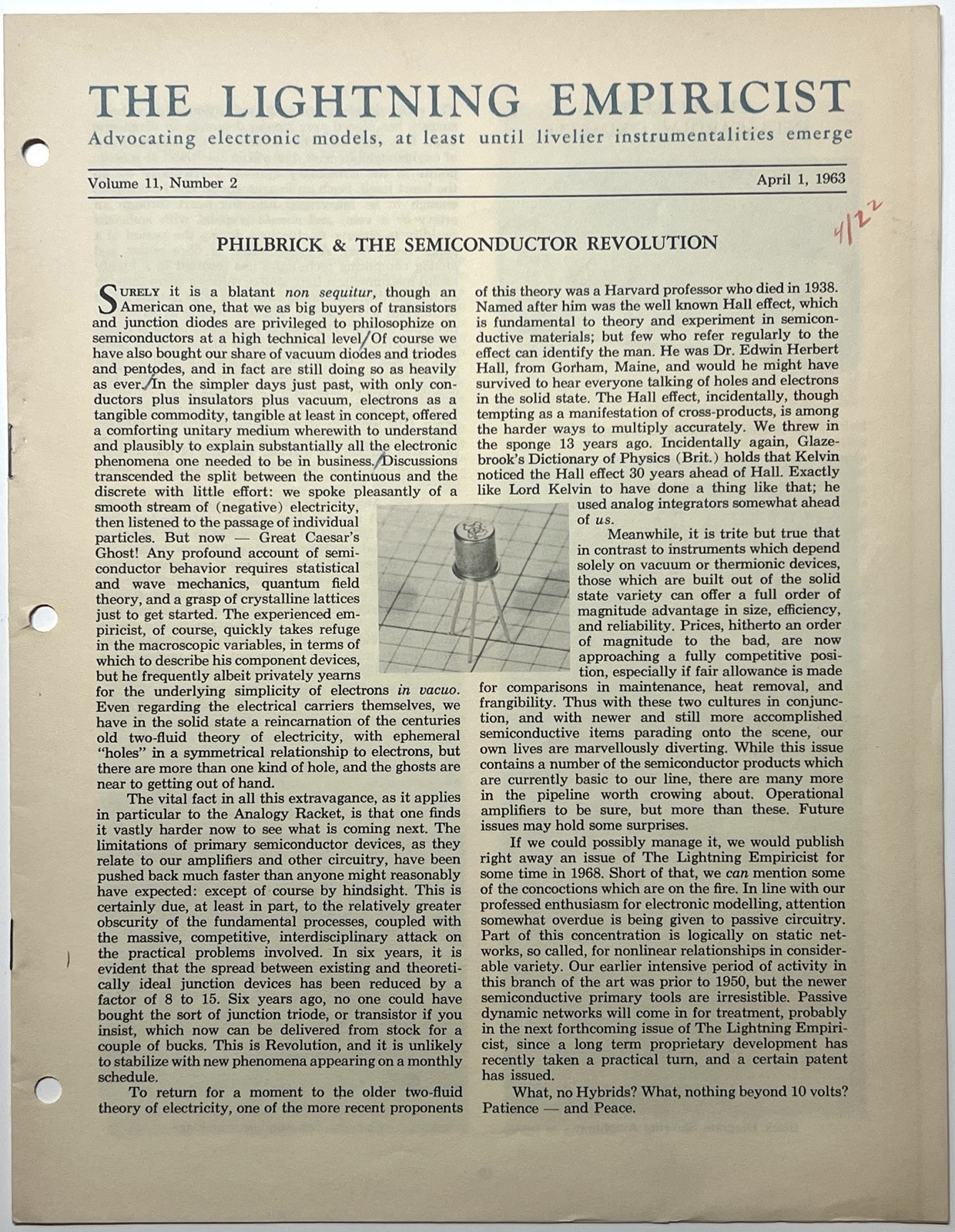
The Lightning Empiricist, Vol. 11, No. 2 (April 1, 1963), the influential house journal of George A. Philbrick Researches (Boston), documenting the company’s pivotal shift from vacuum-tube analog modules to silicon devices. Eight pages in self-wrappers, richly illustrated with photographs, block diagrams, and complete schematics. Lead essay “Philbrick & the Semiconductor Revolution” frames the shop’s move into solid state and the new design practices it required.
Content highlights include Robert Allen Pease’s substantial article “Design of a Modern High-Performance Operational Amplifier”—an early, desirable publication by the legendary analog designer—alongside a biomedical case study, “The Bellevue Intracardiac Oximeter”, showing Philbrick P65 amplifiers at work in clinical instrumentation. Several pages survey contemporary modules and supplies: P45 solid-state op amp; PR-150 and PR-150C regulated supplies (plus junior PR-30/PR-30C); P2 vacuum-tube differential op amp (the classic workhorse of mid-century analog computing); P5 current booster; P65 and P66 differential amplifiers and followers; PP65 epoxy-potted differential amplifier; SP656 chopper-stabilized amplifier; and related 6151-series units. The issue offers performance notes (gain, offset, noise, temperature behavior), typical externals, and application comments valuable to historians and bench users alike.
Philbrick’s modular amplifiers—beginning with the P2 (early 1950s)—were the first broadly marketed op-amp building blocks, the backbone of laboratory analog computing, industrial control, and early biomedical measurement. By 1963 the firm stood at the center of the “semiconductor revolution”; this newsletter captures that transition in real time, pairing theory (Hall effect discourse and analog-as-model arguments) with practical circuits. For collectors of early op-amp technology and followers of Bob Pease’s later career at National Semiconductor, this is a concise, primary-source snapshot from the Boston shop that taught a generation how to think in op-amp blocks.
This is a clean, sound example showing expected gentle toning to the paper and a small penciled date notation at the upper front corner. Three tidy binder punch holes at the inner margins (likely for filing). Minor handling to edges and corners, pages uniformly bright with crisp halftones and legible schematics; no tears observed and no intrusive markings inside. A well-kept shop copy that presents neatly in hand.
Make sure to see the photos above for complete details.
8 pages.
Measuresapproximately11 inches tall by 8 1/2 inches wide.
KEYWORDS
Lightning Empiricist, The Lightning Empiricist, 1963 Lightning Empiricist, Philbrick, Philbrick Researches, George A Philbrick, GAP/R, GAP R, Boston electronics, Clarendon Street Boston, analog computer, analog computing, operational amplifier, op amp, opamp, differential amplifier, instrumentation amplifier, follower, current booster, chopper stabilized amplifier, chopper stabilized, solid state amplifier, vacuum tube amplifier, tube op amp, semiconductor revolution, Hall effect, Robert Allen Pease, Bob Pease, early Bob Pease, high performance operational amplifier, Design of a Modern High Performance Operational Amplifier, Bellevue intracardiac oximeter, biomedical instrumentation, medical electronics, American Optical, clinical oximeter, fibre optic oximeter, circuits, schematics, block diagram, circuit board photo, P2 amplifier, Philbrick P2, P45 amplifier, P65 amplifier, Philbrick P65, P66 amplifier, Philbrick P66, PP65 amplifier, epoxy potted amplifier, SP656 amplifier, chopper stabilized SP656, PR-150 power supply, PR-150C power supply, PR-30, PR-30C, 6151 amplifier, unity gain, DC gain, temperature coefficient, low drift, offset voltage, input bias current, noise, bandwidth, unity bandwidth, small signal response, negative response, linear electronics, instrumentation, process control, measurement, data acquisition, vintage electronics, vintage engineering, midcentury technology, technical newsletter, trade catalog, house organ, rare electronics ephemera, early op amp history, history of computing, engineering history, laboratory equipment, test equipment, control systems, response systems, biomedical engineering history, solid state transition, silicon transistors, early semiconductor devices, American engineering, USA printed, April 1 1963, Vol 11 No 2, collectible electronics magazine, original 1960s publication, vintage tech brochure, Philbrick modules, classic analog modules, museum reference, research library copy, shop manual style, three hole punched, clean example
_gsrx_vers_1723 (GS 9.9.3 (1723))