ORION · Local AI Workstation Dual RTX3090Ti + NVLink (48GB VRAM) · Ryzen97900X · 96GB RAM · 4TB NVMe
~164tok/s Gemma-4-12B, one card, MTP speculative decoding (median) ~63tok/s Qwen3.8-27B, single stream, one card (124+ tok/s aggregate at 8 users) 48GB VRAM across two NVLinked cards: big models split across both, or two models at once ~640TOPS INT8 Tensor Core peak, both cards combined (theoretical, dense)
The token speeds were measured on this machine in September 2026; test conditions are listed below. TOPS is a theoretical peak, not a measurement.
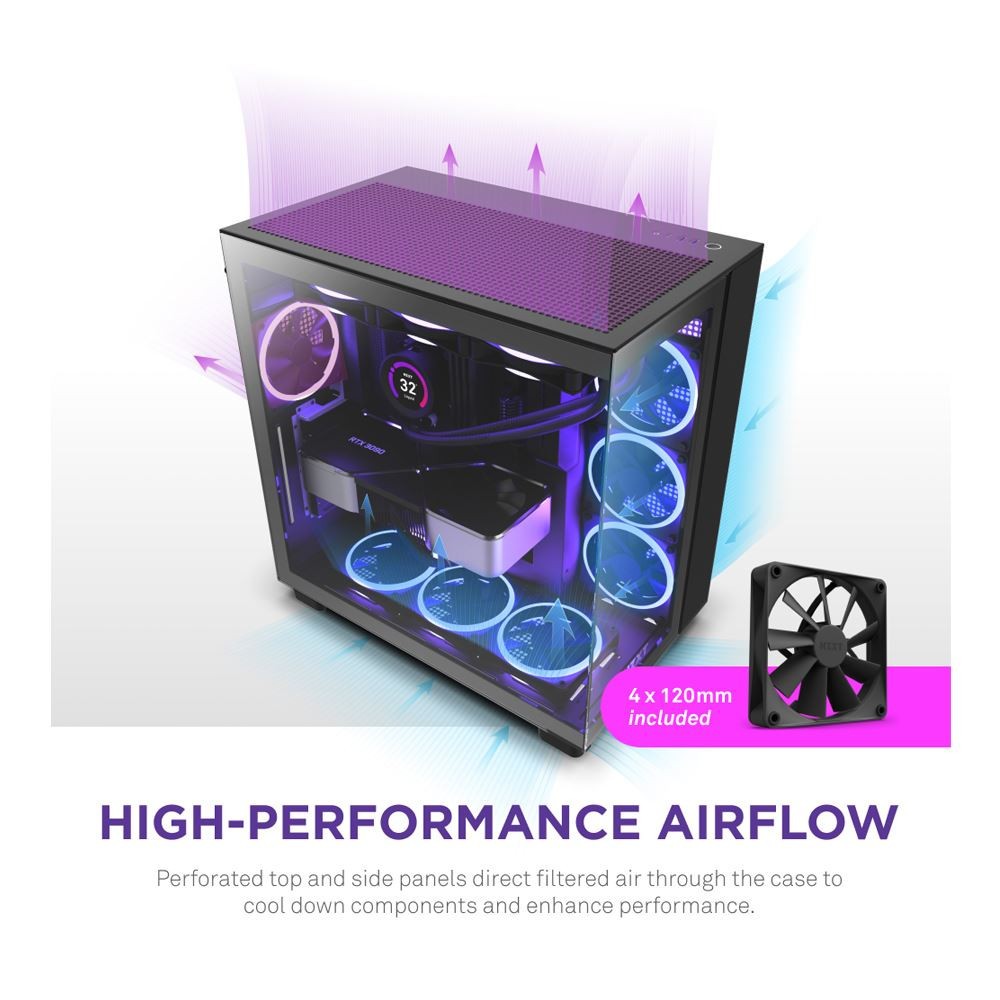
Components 2× RTX 3090 Ti Founders Edition ASUS ROG STRIX X670E-E GAMING WIFI AMD Ryzen 9 7900X NZXT H9 Flow case H9 Flow airflow layout (4×120mm fans included) H9 Flow rear chamber: PSU and drive bays
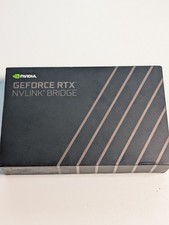
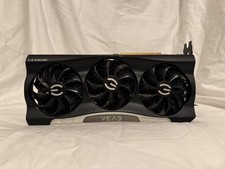
These are manufacturer product images of the components. Photos of this exact machine appear in the listing gallery above.
Hardware GPUs2× NVIDIA GeForce RTX 3090 Ti Founders Edition. Each card has 24GB GDDR6X on a 384-bit bus, 10,752 CUDA cores, 3rd-gen Tensor Cores, a 1.86GHz boost clock, NVENC (7th gen) and NVDEC (5th gen). NVLinkNVIDIA 3-slot NVLink bridge (RTX A6000 / A-series 3-slot kit, RTXA6000NVLINK3S), included and installed. The driver reports a live 4-link (NV4) connection: about 56GB/s each way, 112.5GB/s offerirectional, for direct GPU-to-GPU traffic when a model is split across both cards. CPUAMD Ryzen 9 7900X: 12 cores / 24 threads, 4.7GHz base / up to 5.6GHz boost, 170W TDP, 64MB L3 cache, AVX-512 (including VNNI and BF16) Integrated graphicsAMD Radeon (Raphael) iGPU drives the desktop display, so both 3090 Tis are left entirely free for compute MotherboardASUS ROG STRIX X670E-E GAMING WIFI (AM5, PCIe 5.0, DDR5) Memory96GB DDR5 (4 DIMMs): G.Skill Flare X5 64GB kit (2×32GB, DDR5-6000 CL30) plus G.Skill Flare X5 32GB kit (2×16GB, DDR5-6000 CL32), AMD EXPO. It currently runs at 3600MT/s for four-DIMM stability. Storage4TB WD_BLACK SN850X NVMe (PCIe 4.0) for the OS and models
2TB Seagate Barracuda 3.5" HDD (ST2000DM006)
1TB WD Blue 2.5" HDD (WD10JPVX) Power supplyCorsair HX1500i (1500W, 80PLUS Platinum, fully modular, with digital monitoring over USB that Linux can read). It has plenty of headroom for two 450W cards. NetworkingIntel I225-V 2.5GbE and Intel AX210 Wi-Fi 6E with Bluetooth Case / coolingNZXT H9 Flow dual-chamber mid-tower (tempered glass, perforated top and side panels, 4×120mm fans included, black) with an EK Nucleus AIO CR360 Lux D-RGB 360mm liquid CPU cooler Operating systemUbuntu 24.04 LTS (native Linux, no Windows), NVIDIA 595-series driver, CUDA 13 Measured LLM performance (on this machine)
These are real benchmark runs from September 2026, not spec-sheet numbers. In the setup below, each model ran on its own card so that two models are served at the same time. The cards can also work together on one larger model (see below).
Card 1: Qwen3.8-27B (27-billion-parameter text model)
Output typeWithout MTPWith MTP Code55.4 tok/s151.1 tok/s Structured output (JSON, tables)55.3 tok/s191.0 tok/s Prose55.5 tok/s109.6 tok/s Overall median55.4 tok/s164.7 tok/s (+197%)
All figures are generation (decode) speed at temperature 0, median of 3 runs, with requests sent straight to the engine. Results depend on the model, quantization and prompt. Under sustained load each card draws about 445W.
Theoretical peak compute (RTX 3090 Ti specification) PrecisionPer cardBoth cards FP32 (CUDA cores)40 TFLOPS80 TFLOPS FP16 / BF16 Tensor (dense / sparse)160 / 320 TFLOPS320 / 640 TFLOPS INT8 Tensor (dense / sparse)320 / 640 TOPS640 / 1,280 TOPS INT4 Tensor (dense)640 TOPS1,280 TOPS Memory bandwidth1,008 GB/s2,016 GB/s
These are theoretical peaks derived from the GA102 architecture at the 3090 Ti's 84 SMs and 1.86GHz boost clock, not measurements. Real LLM speed is mostly limited by memory bandwidth, which is why the measured tokens/s above is the better guide.
How it compares with an NVIDIA DGX Spark
NVIDIA's DGX Spark is the obvious "AI box" alternative today. It is a very good machine, built for a different trade-off. The Spark gives you more memory, and ORION gives you much faster memory. For running LLMs, memory speed largely sets how fast answers come back.
DGX Spark (128GB)ORION Memory for models128GB unified (shared by CPU and GPU)48GB GDDR6X VRAM (2×24GB, NVLinked) plus 96GB system RAM Memory bandwidth273GB/s1,008GB/s per card, 2,016GB/s total (about 3.7× per card, 7.4× combined) Headline AI compute"Up to 1 petaFLOP" FP4 (sparse); native FP8 and FP4~640 INT8 TOPS dense (2 cards); FP16/BF16, INT8 and INT4. No FP8/FP4 hardware. CPU20-core Arm12-core / 24-thread x86 (runs all standard Linux and Windows software) Run two models at onceThey share one GPU and one memory poolYes. Two independent GPUs. UpgradeableNo (sealed compact unit)Yes. Standard ATX parts, 1500W PSU, room for future GPUs. Size and powerPalm-sized and low powerFull tower, about 445W per GPU under load Price, newLaunched at $3,999. Retail as of October 2026: about $6,950 (Micro Center) to $9,899 (Newegg). A 64GB version from PC makers is announced from $4,999.This listing, with the platform stack included What the bandwidth gap means in practice
To produce each word, an LLM has to read its weights from memory, so bandwidth caps how fast text comes out. Using the Spark's published 273GB/s:
ModelSpark ceiling*ORION measured Gemma-4-12B, 8-bit (~12.5GB)≤~22 tok/s55 tok/s (165 with MTP) Qwen3.8-27B, 4–6-bit (~18GB)≤~15 tok/s62–64 tok/s
*Theoretical ceiling without speculative decoding: model size divided by 273GB/s. This is not a Spark benchmark, and real results land at or below it. The ORION figures are measured; see the performance section.
Choose the Spark if you need to run very large models (100B+ parameters, or 70B at 8-bit) and value a small, quiet, low-power box with NVIDIA's warranty.
Choose ORION if you want the fastest responses from the 7B–70B models people actually use day to day for coding, agents, chat and vision. You also get two GPUs for two simultaneous workloads, a standard upgradeable x86 workstation, and a pre-integrated SSO, secrets and observability platform, for less than a new Spark costs at retail today.
What a private AI workstation does for you No per-token bills, no rate limits. Run agents all night, re-run a 30K-token document as often as you like, and point every tool at your own OpenAI-compatible endpoint. The running cost is electricity. Your data never leaves the room. Contracts, source code, medical or financial records, and client files are all processed locally. Nothing goes to a third-party API. Agentic coding. Point coding agents and IDE assistants at a 27B model with a 64K-token window. The box already runs a self-hosted agent framework with web search, a headless browser, a memory database and terminal tools wired in over MCP. Two models at once, or one big one. Run a reasoning/coding model on one card and a fast vision model on the other. Or split a single larger model across both NVLinked cards with llama.cpp or vLLM (tensor parallel), giving it 48GB of VRAM. That is enough for 70B-class models at 4-bit. Audio and video pipelines. Tooling is set up for local speech-to-text (faster-whisper) and text-to-speech (Piper). It routes voice from a desktop mic, Discord and Slack into the agent. Each GPU also has hardware NVENC/NVDEC for transcoding and video work. RAG and long-term memory. An in-cluster embedding server (BGE) feeds a vector-indexed SurrealDB memory store, and Postgres runs alongside it. You can build search over your own documents. Fine-tuning and experiments. It ships with LoRA fine-tuning scripts, MLflow experiment tracking and JupyterLab. Engines are interchangeable per card: llama.cpp, SGLang, vLLM and ninfer manifests are all included. Lots of system RAM and fast storage. 96GB of DDR5 and 4TB of NVMe give you room to keep a library of model checkpoints, datasets and containers on hand. The "LLC in a box" platform
This box does more than inference. It has run a small company's self-hosted IT stack on a single-node Kubernetes cluster, built from version-controlled manifests in 8 deployment phases. A fresh Ubuntu install bootstraps from a cloud-init seed. Everything an engineer usually spends weeks wiring together is already integrated:
OrchestrationRKE2 Kubernetes v1.35 (single node), Traefik ingress, NVIDIA container runtime with per-GPU pinning, Headlamp dashboard Identity / SSOKeycloak OIDC realm, with oauth2-proxy forward-auth in front of web apps. One login across your services, and Guacamole remote desktop can also sign in with Keycloak OIDC. SecretsHashiCorp Vault with an auto-unsealer. External Secrets Operator syncs Vault into Kubernetes secrets, and a Vault MCP server gives AI agents controlled access to them. TLS and exposurecert-manager issues Let's Encrypt certificates through Cloudflare DNS-01. A Cloudflare Tunnel publishes services with no open inbound ports on your router, and remote SSH can sit behind Cloudflare Access. DataCloudNativePG (Postgres operator), SurrealDB with the Surrealist UI and an MCP server, Redis, and a scheduled database backup CronJob ObservabilityPrometheus, Grafana, Alertmanager, Loki (logs), Tempo (traces) and an OpenTelemetry collector AI / MLAn LLM engine on each GPU, an embedding server, MLflow, JupyterLab, LoRA fine-tuning scripts, and a context-compression proxy in front of the models Developer and agent toolscode-server (VS Code in the browser), a private SearXNG search engine, a headless Browserless Chrome for agents, and a self-hosted AI agent framework with MCP tools
Rebrand it to your domain. About 16 web services sit behind subdomains. Point your DNS at Cloudflare, put your domain in the ingress and Keycloak realm settings, issue certificates, and you have an SSO-protected private cloud: auth.yourco.com, code.yourco.com, grafana.yourco.com, lab.yourco.com, and so on.
To be clear about the scope: this is web SSO with OIDC, not a Windows Active Directory domain controller. It is a well-integrated starting point that a technical buyer can harden and adapt. It is not a managed or supported product.
How it ships [PLACEHOLDER: choose one and delete the rest. If you choose B or C, trim or remove the "LLC in a box" section and the "Rebrand it to your domain" paragraph so the listing matches what ships.]
Option A (recommended): All drives securely wiped. Ubuntu 24.04 is reinstalled with the NVIDIA driver, RKE2 and the full platform stack deployed fresh, using new secrets and no personal data. It is ready to point at your domain. Setup notes are included.
Option B: Drives wiped. Clean Ubuntu 24.04 with the NVIDIA driver and CUDA working, plus the deployment manifests and a setup guide for standing up the stack yourself.
Option C: Hardware only. Drives wiped, no OS.
Optional for the right buyer: a clean baseline fork of the platform repository. It contains all the cloud-init and Kubernetes manifests, with setup runbooks for the identity, secrets, TLS, inference and observability components. You get the same blueprint this box was built from, ready for your own domain and team. [PLACEHOLDER: included, or available by arrangement? price?]
Good to know
- The 48GB of VRAM is two 24GB cards. To use it for one model, the inference engine splits the model across both cards. llama.cpp (layer/row split) and vLLM (tensor parallel) have been tested doing this on this machine. Engines that run on one GPU only, such as ninfer, use one card each.
- The cards link to the motherboard at PCIe x8 and x4. GPU-to-GPU traffic goes over the NVLink bridge instead. All benchmarks above were measured in this configuration.
- Power: about 445W per GPU under sustained inference. Budget for a dedicated 15A or better circuit if you run both cards flat out.
- The speeds above were measured with the quantizations listed. Other models and formats will perform differently.
Included
- Complete assembled workstation as described above
- Power cable
- NVIDIA 3-slot NVLink bridge (installed)
- [PLACEHOLDER: original boxes? motherboard accessories and Wi-Fi antenna? spare PSU cables?]
Not included: monitor, keyboard, mouse, speakers or headset, unless they are listed above.
Shipping and condition
[PLACEHOLDER: condition notes, age of components, packing method (GPUs removed and packed separately is recommended), local pickup option, handling time]